
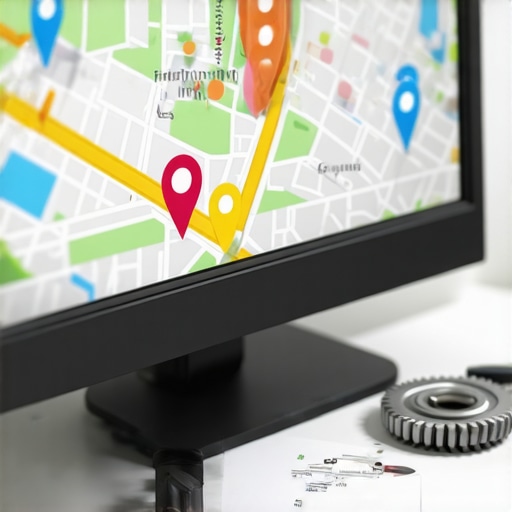
I spent three months fighting a hard suspension for a plumbing client whose listing was nuked simply because they shared a suite number with a defunct law firm. Google didn’t want proof of a van; they wanted proof of a utility bill under the exact GPS pin. I stood on the wet concrete outside that office, smelling the damp city air, and realized the digital map was glitching. The algorithm saw two entities in one physical slice of space and simply chose to delete the newcomer. This is the reality of the hyper-local layer where the math of proximity often outweighs the quality of your service. If your local pages are not showing up, it is rarely a content problem; it is an entity reconciliation failure.
The ghost in the GPS coordinates
**Entity reconciliation** requires aligning **latitude and longitude** coordinates with **NAP data** across the **Local Search Ecosystem**. Indexing failures often occur when **Google’s Knowledge Graph** detects a **centroid conflict** or a **duplicate entity** at the same **physical location**, necessitating a strategy for [how to wipe incorrect business info from the web for good](https://ranklocalmapresults.com/how-to-wipe-incorrect-business-info-from-the-web-for-good). Every pixel on the map represents a data point that must be unique. When you share a building with twenty other businesses, your digital footprint becomes blurred. I have seen countless local landing pages fail to index because the server headers were sending the wrong location signals or the embedded map was pulling from a defunct CID. You must ensure your technical stack is not broadcasting ghosts.
“Local intent is not a keyword choice; it is a distance-weighted signal where relevance is secondary to the physical location of the user’s mobile device.” – Map Search Fundamental
Why your physical address is a liability
**Physical addresses** become liabilities when they are flagged as **virtual offices**, **UPS stores**, or **coworking spaces** that violate **Google Business Profile Guidelines**. Google uses **Street View imagery** and **third-party data** to verify if a business truly occupies a space, often leading to a [business profile suspension](https://ranklocalmapresults.com/why-your-business-profile-suspension-might-be-a-blessing-in-disguise) if the location lacks permanent signage. The algorithm is skeptical of high-rise buildings with hundreds of ‘suites’ that are actually just mailboxes. To fix this, you need to provide what I call sensory proof. This means high-resolution photos of your front door, your specialized equipment, and your branded vehicles parked in the designated spot. If Google cannot ‘see’ you through its data partners, it will not index your location page because it does not believe you exist in the physical world.
Local Authority Reading List
- [Expert tips for local businesses](https://ranklocalmapresults.com/navigating-map-results-ranking-expert-tips-for-local-businesses)
- [Unlocking map results secrets](https://ranklocalmapresults.com/unlocking-map-results-secrets-to-improving-your-local-map-position)
- [The ultimate guide to rank higher in 2025](https://ranklocalmapresults.com/the-ultimate-guide-to-rank-local-results-higher-in-2025)
- [Strategic approaches to dominating local map results](https://ranklocalmapresults.com/strategic-approaches-to-dominating-local-map-results-in-2025)
The three mile radius that determines your revenue
**Proximity signals** create a **geofenced visibility radius** where a business is eligible to appear in the **Map Pack** based on the **user’s current location**. If your page won’t index for searches outside a tight **three-mile radius**, it is likely due to **centroid bias** or a lack of **hyperlocal trust signals** that [technical seo fixes](https://ranklocalmapresults.com/technical-seo-fixes-that-specifically-boost-your-local-visibility) can address. The physics of the map is unforgiving. If you are a locksmith in a dense city, your visibility might drop off after just four blocks. This isn’t a penalty; it is the algorithm prioritizing the shortest travel time. To expand this, you must build what I call behavioral momentum. This involves getting customers from neighboring zip codes to interact with your profile, search for your brand by name, and trigger directions requests from varied GPS starting points.
The hidden forensic trace of service area polygons
**Service Area Businesses** must define their **service area polygons** in the **GBP dashboard** without overlapping too aggressively with distant competitors. Indexing issues for SABs usually stem from **verification tier mismatches** where the **business address** used for mailers does not match the **service radius** broadcasted on the website, which is why [recovering from a google penalty](https://ranklocalmapresults.com/recovering-from-a-google-penalty-a-local-business-case-study) often involves a total audit of location data. When you hide your address, Google relies heavily on your ‘neighborhood’ mentions in your site’s copy. If your site mentions ten different cities but your profile only covers three, the discrepancy triggers a trust filter. You need to align your service area boundaries with the actual flow of your service vans.
“Relevance is the match between a business and a search query, but distance is the ultimate tie-breaker in the local algorithm’s decision-making process.” – Location Intelligence Whitepaper
Mathematical weight of local review sentiment
**Review sentiment** is a **ranking signal** where **natural language processing** extracts **service keywords** and **location entities** from user feedback to trigger **review justifications** in search results. Pages fail to index for specific terms when they lack [ethical review strategies](https://ranklocalmapresults.com/the-ethical-review-strategy-that-gets-results-without-using-bots) that encourage customers to mention the specific neighborhood or the exact service performed. It is not about the star rating alone. It is about the vocabulary. If your customers write ‘Great job,’ you gain nothing. If they write ‘The best plumber in Downtown Austin who fixed my leaky pipe,’ you gain an entity association. This is the difference between being a generic business and being a local authority.
The specific JSON-LD attributes that trigger voice search
**LocalBusiness Schema** must include **geo-coordinates**, **opening hours**, and **sameAs links** to social profiles to provide the **structured data** required for **AI Overviews** and **voice search**. Many local pages remain unindexed because their [local schema markup](https://ranklocalmapresults.com/the-local-schema-markup-we-use-to-beat-multi-location-competitors) is missing the **@id URL**, which prevents Google from connecting the website to the **Map Listing**. You must go beyond basic NAP. Include your ‘PriceRange,’ your ‘AreaServed,’ and even specific ‘Department’ schema if you are a multi-faceted business like a car dealership with a service center. This technical depth tells the algorithm that you are a complex, verified entity rather than a thin lead-gen site.
Forensics of a storefront data glitch
**Image metadata** and **EXIF data** from photos taken at a **physical business location** provide **authenticity signals** that verify the business is active and legitimate. Uploading stock photos is a fast way to get ignored by the index, whereas using [4 photo tweaks](https://ranklocalmapresults.com/4-photo-tweaks-that-actually-boost-your-google-maps-impressions) can dramatically increase your visibility. I have investigated profiles that were suppressed for months only to find they were using images with metadata from a different state. The algorithm is smart enough to see the GPS tags in the image file. If you want to index, take a real photo of your office with your phone, leave the location services on, and upload it directly. It is the digital equivalent of a fingerprint.