
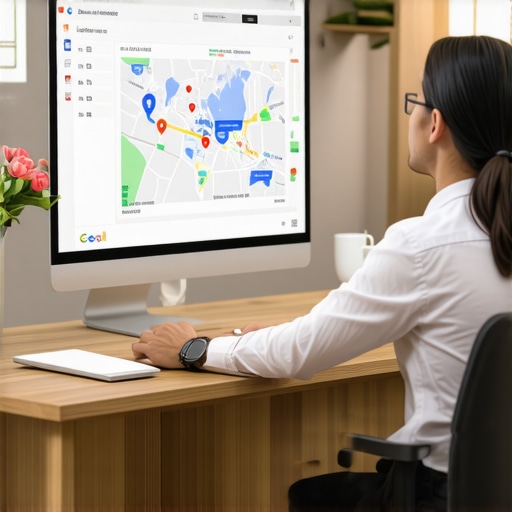
4 Photo Tweaks That Actually Boost Your Google Maps Impressions
The “Map Pack” is no longer just a digital phonebook; it is the primary battleground for local commerce. When a potential customer searches for “plumber near me” or “emergency roof repair,” they aren’t looking at your website first – they are looking at your Google Business Profile (GBP). However, many business owners treat their profile imagery as an afterthought, uploading a few low-resolution shots from 2019 and wondering why their visibility has stagnated.
At the desk of Shahid Anwar, we view Local SEO not as a marketing gimmick, but as essential business infrastructure. If your digital infrastructure is crumbling, your lead flow will follow. In the 2025-2026 landscape, Google has integrated Gemini AI to analyze crowdsourced and owner-uploaded photos with unprecedented speed and accuracy. Google isn’t just “hosting” your photos anymore; it is “reading” them to determine if your business is the most relevant answer to a user’s query. To dominate the local rankings, you must optimize your visual data for both the algorithm and the human eye.
Why Google’s Vision AI Changed the Photo Game
To understand why photo tweaks matter, you must understand the technology behind the screen. Google utilizes the Cloud Vision API and Gemini AI to categorize businesses based on visual cues. This is a shift from simple metadata to “Entity Recognition.” When you upload a photo, Google’s AI scans the image for objects, text, and context. If you are a specialized HVAC contractor but your profile is filled with generic office handshakes and stock images of blueprints, Google’s AI may fail to categorize you for high-intent keywords like “AC compressor repair.”
This falls under the core pillars of Local SEO: Relevance and Prominence. Relevance is determined by how well your business matches the search intent. If Google’s Vision AI detects tools, branded trucks, and specific job-site equipment in your photos, your relevance score for those specific services skyrockets. Prominence is boosted when users interact with your photos – zooming in, scrolling, and spending “dwell time” on your profile imagery.
Failure to align your visual content with your service keywords is a leading cause of ranking stagnation. For a deeper dive into how the “invisible” parts of your photos impact your standing, see our guide on How Hidden Meta-Data in Your Storefront Photos Can Help You Rank Local Results. By aligning your visual “infrastructure” with AI expectations, you ensure that Google’s algorithm views your business as the definitive local authority.
Tweak #1: Technical Precision (The 720px Rule)
The first tweak is purely technical. Many business owners make the mistake of uploading massive, 20MB professional RAW files or, conversely, tiny, blurry screenshots. Both are detrimental to your google business profile seo. High-resolution files that haven’t been optimized for web delivery can slow down the loading speed of your profile on mobile devices, leading to a poor user experience and lower engagement signals.
According to Google’s official documentation and our internal testing, the “Sweet Spot” for technical precision follows these standards:
- Format: JPG or PNG (JPG is generally preferred for its balance of quality and file size).
- Size: Between 10 KB and 5 MB.
- Resolution: The recommended standard is 720 x 720 pixels. The absolute minimum is 250 x 250 pixels.
Why 720px? This resolution is high enough to appear crisp on high-density smartphone displays (Retina displays) while remaining small enough for Google’s Vision AI to process instantly. When an image is perfectly sized, it passes the “AI-Human Test.” The AI can clearly identify the objects in the frame without being bogged down by excessive data, and the human user sees a professional, sharp representation of your work. If your images are pixelated, Google may filter them out of the primary “Photos” carousel, effectively hiding your best work from potential clients. This is a fundamental step in any The Map Ranking Checklist We Use for Every New Client Audit.
Tweak #2: Geotagging and EXIF Metadata (The Proximity Signal)
There is a long-standing debate in the SEO community regarding geotagging. While it is true that Google often strips Exchangeable Image File (EXIF) metadata upon the final upload to the public-facing profile for privacy reasons, the initial “ingestion” phase is where the magic happens. When you upload a file, Google’s crawlers read the original file’s data before it is processed and compressed.
EXIF Metadata includes technical architecture such as:
- GPS Coordinates (Latitude and Longitude)
- The date and time the photo was taken
- The device used (proving it’s a real photo, not a stock download)
- Camera settings (Aperture, ISO)
This data acts as a “Proximity Signal.” If you are a roofer claiming to serve a 20-mile radius, but all your photos were taken at your home office, you aren’t providing “Proof of Proximity.” The most actionable advice here is to ensure that your team has smartphone GPS “Location Services” turned ON when taking photos at job sites. These “Proof of Work” photos carry the coordinates of the actual service area, signaling to Google that you are active and physically present in the locations you claim to serve. This strategy is one of the 5 Photo Tweaks That Doubled Map Views for Our Clients and remains a cornerstone of advanced proximity optimization.
Tweak #3: Contextual Relevance (The “Proof of Work” Signal)
Stop using stock photos immediately. In the era of Gemini AI, stock photos are a liability. Google’s algorithm is now sophisticated enough to recognize “excessive use of filters” or “significant alterations.” More importantly, it can identify images that appear on thousands of other websites. If your profile uses the same “smiling contractor” photo as ten other businesses in your city, your prominence will tank.
To rank higher on google maps, you must provide contextual relevance through “Proof of Work” signals. This means uploading raw, authentic imagery that tells a story of a functioning business infrastructure.
The Contextual Checklist:
- Branded Assets: Photos of your trucks, uniforms, and equipment featuring your logo. This reinforces your “Entity” in Google’s Knowledge Graph.
- The Storefront Entrance: Google explicitly looks for photos of the building entrance to help users find you. This is a major trust signal.
- Action Shots: A plumber actually soldering a pipe or a landscaper operating a mower. These photos contain “labels” that Google’s Vision AI uses to categorize your services.
Authenticity breeds conversion. A customer is far more likely to call a contractor after seeing a photo of a real team on a real local street than after seeing a polished, fake stock image. For more common pitfalls to avoid, read 3 Business Profile Photo Mistakes That Are Scaring Away Local Customers.
Tweak #4: The Velocity and Freshness Factor
Local SEO is not a “set it and forget it” task. It is a living system. One of the most overlooked ranking factors is Photo Velocity. Google rewards active profiles because freshness indicates that the business is still operational and engaged with its community. A profile with 100 high-quality photos from 2021 is considered “stale” or “dead” compared to a competitor who uploads 3 to 5 new photos every month.
By using local seo tools to schedule or track your uploads, you can maintain a consistent “Freshness Signal.” You don’t need a professional photoshoot every week. A simple smartphone photo of a completed project, a new piece of equipment, or even a “behind the scenes” look at your office is enough to tell Google’s algorithm that your business is thriving. This consistent activity keeps your profile at the top of the “Recently Updated” filters that Google often applies to local searches. This is a key component of The Ultimate Guide to Rank Local Results Higher in 2025.
Looking Ahead: Google Maps SEO in 2026
As we move toward 2026, the integration of haptic maps and smart-city hubs will make visual data even more critical. We are entering the era of “Zero-Click” results, where Google provides the answer directly in the search interface without the user ever visiting your website. In this environment, your photos are your storefront. The quality, relevance, and technical optimization of your visual data will determine whether you are the “Recommended” choice by an AI assistant or if you are buried on page three of the map results.
Conclusion & Call to Action
Photos are the “eyes” of your Google Business Profile. They allow Google to see what you do, where you do it, and how well you do it. By implementing the 720px rule, ensuring GPS metadata is present, focusing on contextual “Proof of Work,” and maintaining a steady upload velocity, you move your profile from a static listing to a dynamic lead-generation machine.
As Shahid Anwar often says, “Local SEO isn’t marketing. It’s infrastructure. We engineer profiles for maximum relevance.” Do not let poor imagery be the bottleneck in your business growth. If you are ready to see where your business stands in the current landscape, perform a google maps ranking service audit today and start treating your profile with the technical respect it deserves.
About the Author: Shahid Anwar
I’m Shahid Anwar, a Local SEO & Google Business Profile specialist. I help local and multi-location businesses turn Google Maps and local search visibility into consistent revenue. My approach treats SEO as a technical infrastructure project, focusing on the deep-level optimizations that the modern AI-driven algorithm demands. With years of experience in GMB/GBP management, I empower business owners to dominate their local markets through data-backed strategies.