
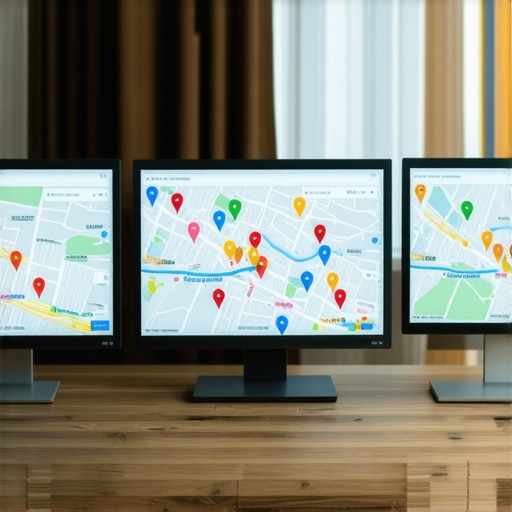
The invisible grid that kills local profits
I spent three months fighting a hard suspension for a plumbing client whose listing was nuked simply because they shared a suite number with a defunct law firm. Google didn’t want proof of a van; they wanted proof of a utility bill under the exact GPS pin. This is the reality of the hyper-local layer. It is a world where wet concrete and physical evidence outweigh any digital fluff. When you start looking at the maps ecosystem through a lens of forensic accuracy, you realize that most software is just guessing. You see the glitch in the storefront data. You notice the mismatched phone number in a secondary verification tier. These tools promise a world of easy wins, but the algorithm is a cold spatial database that does not care about your dashboard. It cares about the math of proximity and the hard truth of a business entrance that might face an alley instead of a main street. This discrepancy is where most businesses lose their ranking, falling into the gap between what the software reports and what the mobile user actually experiences on the sidewalk.
Why software cannot see the wet concrete
Local SEO tools and top google business profile seo toolkits often fail because they rely on static API data rather than real-time spatial signals. Ranking requires proximity salience, verified GPS pins, and customer behavioral data which third-party listing management software cannot simulate effectively. Real success comes from on-the-ground proof and high-quality local citations. You cannot fix a proximity issue from a desk in a different time zone. The algorithm is looking for the movement of mobile devices. It tracks the dwell time of a customer in your lobby. It notes the signal strength of the Wi-Fi routers in your vicinity. Most people think they are buying a solution when they subscribe to a monthly service, but they are often just buying a mirror that reflects their own errors back at them. If your reality check on the GMB toolkit vs generic SEO apps reveals a gap, it is because the software is blind to the physical friction of your location. You might have a perfectly optimized profile, but if your entrance is blocked by a construction project for six months, your foot traffic data will plummet, and your ranking will follow. Software cannot see the orange cones; it only sees the data points that have already failed.
“Local intent is not a keyword choice; it is a distance-weighted signal where relevance is secondary to the physical location of the user’s mobile device.” – Map Search Fundamental
The microscopic math of the GPS centroid
The pin moved. Just a few feet can be the difference between the Map Pack and the second page of search results. We are talking about the physics of a three mile radius shift. When you look at the map ranking checklist we use for every new client audit, the first thing we examine is the coordinate accuracy. Many agencies sell citation blasts to dead directories, thinking volume wins. It does not. One local seo services to fix nap inconsistencies move is worth a thousand low-quality links. The algorithm calculates the centroid of your service area. If you are a service-based business with no physical office, your gmb optimization toolkit for service businesses must focus on the polygon of your actual work sites. We have seen cases where a small service area change fixed a stalled local search rank because it aligned the business with the actual density of its customer reviews. This is spatial logic. It is the math of the neighborhood. If your coordinates are even slightly off, you are sending a signal of distrust to the engine. The engine wants certainty. It wants to know that when it sends a user to a location, that user will find a door, a sign, and a person ready to do business. Anything less is a risk to the user experience, and Google is in the business of minimizing that risk at all costs.
Local Authority Reading List
- Why neighborhood sponsorships beat generic backlinks
- 3 missing trust signals sabotaging your rankings
- 5 local SEO tools we use every day
- 4 step checklist to fix ranking stagnation
The three mile radius that determines your revenue
Local search rankings are dictated by a distance-weighted proximity signal where the physical location of the user is the primary ranking factor. To optimize for Google Business Profile, you must ensure NAP consistency, verified location data, and neighborhood-specific content that anchors your business to a geographic centroid. This is why a step by step gmb ranking toolkit for beginners often starts with the basics of address verification. But once you move past the basics, you enter the domain of behavioral signals. The algorithm is watching. It knows how many people click for directions and then never actually arrive. It knows if people are searching for your brand name from a specific suburb. If you are looking for the proximity move that ranks you in crowded suburbs, you have to look beyond the dashboard. You need to understand the flow of traffic. You need to know why a competitor with fewer reviews is outranking you. Often, it is because their local seo tools to optimize google business profile listing are actually just a cover for the fact that they have better foot traffic data. They have more people physically visiting their location with their GPS enabled. This creates a feedback loop of trust. The engine sees the movement, verifies the location, and rewards the listing with higher visibility. It is a system built on physical proof.
The forensic ghost in the GPS coordinates
Emergency seo services for a sudden ranking drop must address profile suspensions, broken redirects, and 404 errors that break the local trust signal. Solving gmb ranking loss after address change requires a forensic audit of JSON-LD schema and location intelligence to restore Map Pack visibility and search engine trust. I have seen businesses vanish because of seo services to fix broken redirects and 404 errors that they didn’t even know they had. A single bad link on a forgotten landing page can leak authority like a burst pipe. When we provide google maps seo services for suspended profiles, we aren’t just filling out forms. We are building a case. We are proving to a machine that a business exists in three-dimensional space. This requires photos of the storefront from across the street. It requires shots of the utility meters. It requires a what is a gmb ranking toolkit approach that includes physical documentation. The software can’t take a photo of your lobby. It can’t feel the weight of a business license. These are the signals that matter when the algorithm decides to pull the plug on your visibility. You need to be prepared for the moment the machine asks for proof. If your local seo services to fix nap inconsistencies are only skin deep, you will fail the audit. You need to be deeply rooted in the local grid.
“Proximity is the most powerful ranking factor in the local algorithm; it acts as a filter that relevance and prominence can rarely overcome if the distance is too great.” – Location Intelligence Whitepaper
Why your physical address is a liability
Google Business Profile optimization requires more than just keyword stuffing; it demands spatial relevance and verified physical presence. To combat map-spam and ranking stalls, businesses must utilize local search signals like storefront photos, customer stay time, and hyperlocal schema markup to maintain Map Pack dominance. The problem with many top google business profile seo toolkits is that they encourage a set-it-and-forget-it mentality. But a business is a living thing. Your neighborhood changes. A new building goes up next door and blocks your line of sight. A new highway exit shifts the flow of commuters. If you aren’t adjusting your strategy to match the physical changes in your environment, you are falling behind. We often find that ranking fails if your entrance faces an alley because the Google car couldn’t verify the signage. These are the