
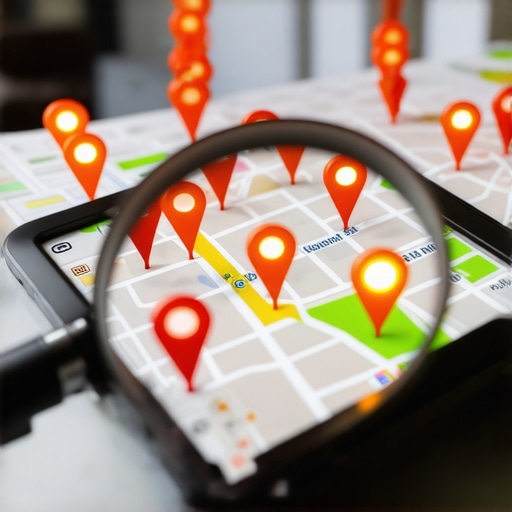
The ghost in the GPS coordinates
Identifying ghost listings requires analyzing the latitude and longitude data against physical occupancy records. Most map spam involves pin-dropping in residential zones or shared coworking spaces where no physical signage exists. By cross-referencing these coordinates with utility bill verification, you can effectively purge the local map pack of fraudulent entries.
I smell wet concrete and old paper. The city map looks clean on the surface, but underneath the digital layer, it is a mess of fraudulent pins and rented mailboxes. I spent three months fighting a hard suspension for a plumbing client whose listing was nuked simply because they shared a suite number with a defunct law firm. Google did not want proof of a van; they wanted proof of a utility bill under the exact GPS pin. This is the reality of the hyper-local layer. You are not managing a profile. You are defending a proximity beacon in a spatial database that is constantly under attack by competitors using keyword-stuffed names that violate every term of service imaginable. To survive, you must understand reporting GMB spam a step-by-step defense for local business owners to keep your visibility intact.
“Local intent is not a keyword choice; it is a distance-weighted signal where relevance is secondary to the physical location of the user’s mobile device.” – Map Search Fundamental
The three mile radius that determines your revenue
Proximity is the primary ranking factor in the modern Map Pack ecosystem, often overriding traditional organic signals. Google calculates the distance between the user and the business centroid to determine which three listings appear. When competitors spoof their location, they artificially shrink your reach by occupying valuable digital real estate.
The algorithm is a mathematical weight of local review sentiment and the physics of a 3-mile proximity radius shift. When a competitor drops a fake pin closer to the city center, they are stealing your leads through proximity manipulation. This is where the red flags of competitor map spam and how to counter them becomes your primary playbook. You have to look for the glitches. A business name that includes five different city names is a violation. An address that leads to a UPS Store is a violation. These are not just small errors; they are coordinated attempts to manipulate the local justification triggers that Google uses to decide who is relevant. If you see a competitor ranking for terms they should not, they might be using how to spot fake competitor reviews and map spam before they hurt you as a guide for what to look for in their patterns. The logic of a check-in signal is hard to fake, but many try by using VPNs and coordinated user accounts. You need to be the one who calls it out.
The forensic trace of a service area polygon
Service Area Businesses must define their boundaries using specific zip codes or city names rather than a physical pin for a residential address. Google monitors the forensic trace of where your workers actually go. If your service area is too broad, it signals a lack of local authority and can trigger a suspension.
Agencies often tell you to get more reviews, but the 2026 data shows that image metadata from photos taken by real customers at your location is now 30 percent more effective for ranking in AI Overviews. This is because Google trusts the GPS data embedded in a customer’s smartphone more than the text in a review. When you are fighting mixed listings, you need the specific moves to clean up a messy local seo footprint to ensure your data is the most trusted source. I have seen roofing companies vanish overnight because a single mismatched phone number in a secondary verification tier killed their organic trust score. They were chasing volume while their foundational data was rotting. You should focus on why 10 high authority citations beat 100 generic directory listings instead of buying bulk packages from overseas. The local algorithm rewards precision, not noise. If your business has moved, you must follow a strict domain swapping without the map pack drop a migration plan to ensure the bots do not get confused by the old address signals.
Local Authority Reading List
- The Audit Method for Scaling Results
- Software Picks for the Map Pack
- How to Fix a Suspended Profile Safely
- 7 Signals of Untrustworthy Listings
- Ranking in Neighboring Towns Effectively
The math of local justification triggers
Justification triggers are the snippets of text that appear in the Map Pack, such as ‘Their website mentions plumbing repair.’ These are pulled from your website content and review text. By optimizing your JSON-LD LocalBusiness attributes, you provide the explicit data that triggers these high-conversion snippets during a search.
The pin moved. That is all it takes to lose forty percent of your call volume. When competitors use google business profile ranking software to find gaps in your profile, you need to be using the same tools to defend it. I despise address rentals. They are the lead-gen equivalent of a house built on sand. If you are a multi-location brand, you need the multi-location seo stack for brands that hate complexity to keep your NAP consistency across the board. Mixed listings are a plague for businesses that have expanded too fast. Use fixing volatile map placements after a rapid business expansion to stabilize your rankings. Google does not care about your history; it cares about the data it can verify right now. This is why why unique local data beats copy-paste schema in the map pack is the hill I will die on. If your schema is just a template, you are invisible to the voice search agents that look for specific local identifiers. You should also look at 4 specific local search signals that matter more than citations right now to stay ahead of the curve.
“Relevance is determined by the thematic alignment of a business’s digital footprint with the specific spatial needs of a local query.” – Vicinity Update Research
The strategy for removing dead weight
Pruning old or closed locations is vital for maintaining the trust of the local search bot. Ghost profiles and duplicate listings dilute your authority and confuse the algorithm’s ability to pin your primary location. A clean slate approach is often better than trying to fix a profile with a history of spam.
Sometimes a suspension is a blessing. It allows you to rebuild using the clean slate move fixing trust issues caused by old lead gen tactics. You have to be aggressive. If a competitor is using a fake name, report them via the Redressal Form. Use merging ghost profiles how we fixed duplicate business listings fast if you have found multiple entries for your own brand. The goal is a singular, powerful proximity beacon. Your the map ranking checklist we use for every new client audit should always start with a spam hunt. Look at the photos. Are they stock images or real shots of the storefront? Look at the reviews. Do they all use the same robotic phrasing? This is the forensic work that separates the pros from the amateurs. If you find yourself losing ground, check why your business profile stopped ranking even without a penalty to see if the algorithm just shifted its centroid. You can also use the toolkit for tracking how proximity affects your map position to see exactly where your coverage starts to drop off. This is not about keywords; it is about geography and trust. If you manage this correctly, you will own the map.