4 Features in Local SEO Tools That Actually Predict Map Ranking Moves
In the world of local search, the “Map Pack” is the ultimate prize. For local service businesses – from plumbers in Phoenix to law firms in London – appearing in those top three spots isn’t just a matter of pride; it is the primary engine for growth. However, achieving and maintaining those rankings has become increasingly volatile. As a Local SEO Consultant and Google Business Profile Product Expert, I’ve seen countless businesses obsess over metrics that simply don’t move the needle. When we talk about google business profile seo, we have to move beyond vanity metrics and look at the data that actually predicts ranking shifts.
Traditional organic SEO tools often fail at local search because they treat a city as a single point on a map. They ignore the reality of how users search on the move. The reality is that Map Pack visibility accounts for roughly 50% of all inbound calls for local service businesses (Source: The Blueprint Training/WEBRIS). If you aren’t tracking your performance with the right google business profile seo tools, you are essentially flying blind. To dominate your market, you need to understand the three core pillars of the Google Maps algorithm: Proximity, Relevance, and Prominence. In this deep dive, we will explore the four specific tool features that allow us to predict, rather than guess, where your business will rank next. Before we dive in, it’s worth reviewing Unlocking Map Results: Secrets to Improving Your Local Map Position to set your foundation.
Feature 1: Geo-Grid Visualization & Proximity Heatmapping
The single most significant mistake agencies make is relying on “single-point” rank tracking. If you check your rankings from your office chair and see you are #1, you might feel successful. But what happens when a potential customer searches for your services from two miles away? In many cases, you might drop to #10 or worse. This is why a sophisticated google maps rank tracker is non-negotiable.
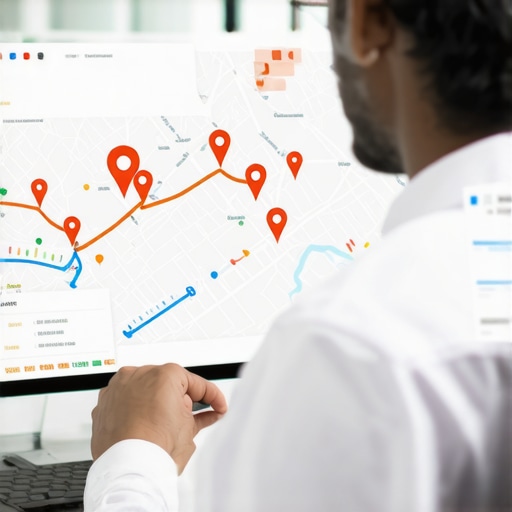
Proximity is arguably the heaviest ranking factor in the local algorithm. Google’s primary goal is to provide the most convenient solution to the user. Tools like SEO Viper Tools or Local Falcon utilize a grid system – often referred to as a geo-grid – to visualize rankings across a physical map. Instead of a single number, you see a heat map of 1s, 2s, 3s, and the dreaded red dots representing lower rankings.
When we analyze a geo-grid, we aren’t just looking for where we are winning; we are looking for the “frontier” of our proximity. If we see a cluster of #1 rankings that suddenly drops off at a specific neighborhood boundary, we can predict that a competitor in that area has stronger “Prominence” or “Relevance” signals that are overcoming our physical proximity. This allows us to stop guessing why we aren’t “ranking in the whole city” and start targeting specific micro-markets. For a deeper look at this phenomenon, see Why Roofers in Large Cities Still Struggle with Proximity Even After an Audit.
Using a google maps rank tracker with geo-grid capabilities also helps us identify “ranking bleed.” This is when your rankings start to shrink inward toward your physical location over time. This is often an early warning sign of a competitor’s aggressive optimization or a Google algorithm update favoring hyper-local results. By spotting these trends early, we can adjust our strategy before the phone stops ringing.
Feature 2: Competitor Signal Gap Analysis
Google uses GBP data as the primary source for local search results. To outrank the top three, you don’t necessarily need to be “better” in a subjective sense; you need to provide Google with more authoritative signals than your competitors. This is where a high-level google business profile audit tool becomes an essential part of your arsenal.
A true gap analysis feature doesn’t just look at your profile in a vacuum. It scrapes the data of the current top 3 rankings for your primary keywords and compares it to yours across dozens of data points. We look at:
- Primary and Secondary Categories: Is a competitor ranking higher simply because they have “Emergency Plumber” as a secondary category while you only have “Plumber”?
- Photo Count and Frequency: Google’s Vision AI analyzes the content of your photos. If your competitors have 200 geotagged photos of actual job sites and you have 10 stock photos, you have a signal gap.
- Review Velocity: It’s not just about total reviews. If your competitor is getting 5 reviews a week and you are getting 1 a month, Google perceives them as more “active” and relevant.
By using a google business profile audit tool, we can reverse-engineer the “success blueprint” of the current winners. We often find that “service gaps” are more important than review volume. For example, if all top-ranking competitors have the “Online Estimates” attribute checked and you don’t, that small omission could be holding you back. You can learn more about this in our guide on How to Spot the Service Gaps Your Local Competitors Are Ignoring.
Predicting a ranking move becomes possible when you close these gaps. If we align our categories, exceed the competitor’s average photo count, and match their review velocity, the algorithm has fewer reasons to keep us below them. This data-driven approach removes the “magic” from SEO and replaces it with a checklist of actionable tasks.
Feature 3: Review Sentiment & Keyword Extraction
The “Relevance” pillar of local SEO is heavily influenced by what your customers say about you. Google doesn’t just count your stars; it reads your reviews. Advanced local seo tools now include NLP (Natural Language Processing) to scan review text for specific keywords and sentiment.
Have you ever noticed “justifications” in the Map Pack? These are small snippets of text under a listing that say “Their website mentions…” or “A reviewer said ‘best plumber in town’.” These justifications are a direct signal that Google is using review content to determine relevance for specific long-tail queries. If you want to improve google maps ranking for a term like “water heater repair,” you need reviews that specifically mention that service.
A predictive tool will analyze the “keyword density” within your reviews compared to your competitors. If the top-ranking competitor has 40 reviews mentioning “fast service” and you have zero, Google may not consider you the most relevant result for a user searching for “fast plumber near me.”
However, I must offer a warning: Review volume alone won’t save you. We’ve seen cases where profiles with 500 reviews are outranked by profiles with 50. Why? Because the 50 reviews are high-quality, detailed, and contain the right semantic keywords, whereas the 500 are generic “Great job!” comments. Furthermore, “Quality Backlinks Outperform Shady Link Schemes” every time, and the same logic applies to reviews. Authentic, keyword-rich sentiment is a leading indicator of a ranking jump. For more on this, check out Why Chasing Review Volume Alone Won’t Help You Outrank Local Competitors.
When our software identifies that we are gaining “keyword authority” in our reviews, we can almost always predict a rise in rankings for those specific terms within 30 to 60 days. It is a slow-burn signal, but one of the most stable once achieved.
Feature 4: Local Entity & Citation Health Auditing
The third pillar, “Prominence,” is about how well-known your business is across the web. This is where local seo software focuses on your “Entity” health. Google doesn’t just look at your GBP; it looks at the consistency of your Name, Address, and Phone number (NAP) across the entire internet.
Monitoring local entity signals is vital. If your business is listed as “Main St. Plumbing” on Yelp but “Main Street Plumbing, LLC” on Google, you are creating “entity friction.” This confusion weakens your prominence. Sophisticated local seo software like SEO Viper helps maintain these signals by auditing your citations and identifying inconsistencies that could be suppressed by the algorithm.
Furthermore, for multi-location businesses, the relationship between your GBP and your website’s location pages is a major ranking factor. A tool that audits your “Local Entity” health will check if your location page uses Schema.org markup correctly. This structured data tells Google’s bots exactly who you are, what you do, and where you are located in a language they can’t misunderstand.
As we look toward the future, maintaining a clean entity becomes even more critical. By 2026, we expect to see “Haptic Maps” and “AI-Auto Displays” becoming standard in local search interfaces. These systems will rely heavily on structured data and clear entity signals to provide voice and augmented reality search results. If your citation health is poor now, you will be invisible in the next generation of search. To stay ahead, refer to The Ultimate Guide to Rank Local Results Higher in 2025.
When we clean up a business’s citation profile and align their on-site local SEO with their GBP, we typically see a “Prominence Boost.” This usually manifests as a wider ranking radius in the geo-grid. You aren’t just ranking better at your front door; you are ranking better five miles away because Google now trusts that your business is a legitimate, prominent entity in that region.
Conclusion: Moving from Guessing to Dominating
The days of “set it and forget it” for Google Business Profiles are long gone. To rank higher on google maps, you must treat your profile as a living, breathing asset that requires constant data-driven refinement. An optimized, active Google Business Profile is the foundation of all local success.
By focusing on these four predictive features – Geo-Grid Visualization, Competitor Gap Analysis, Review Sentiment, and Entity Health – you move away from the frustration of fluctuating rankings and toward a strategy of predictable growth. You stop asking “Why did I drop?” and start saying “I know exactly what to do to move up.”
If your current strategy feels like a series of guesses, it’s time to change your approach. Whether you are an agency managing dozens of clients or a business owner trying to win your local town, the data is there if you have the tools to see it. Don’t leave your most important lead generation source to chance. Audit your profile today and see where the gaps are hiding. If you’re ready to take the next step, check out The Map Ranking Checklist: How We Fixed a Stalled Profile in One Week or reach out to a specialist who can help you navigate the complexities of google business profile seo.
The Map Pack is waiting. Will you be in the Top 3?