
Why Your Mapping Tool Doesn’t Reflect Real-World Local Search Traffic
The air smells like wet concrete and the metallic tang of cold coffee as I stare at another screen showing a sea of green ranking pins that mean absolutely nothing. I have spent two decades as a map-spam investigator and strategist, watching the hyper-local layer evolve from a simple directory into a complex spatial database. Most businesses are chasing ghosts because they rely on tools that simulate searches from a fixed point, failing to account for the jitter of real-world mobile signals. I see the glitches in the storefront data every day; a business looks like a king on their own dashboard while being invisible to the customer standing two blocks away in the rain.
Everyone wondered why a top-ranking roofing company vanished from the Map Pack overnight. I found the problem in their Local Services Ads; a single mismatched phone number in the secondary verification tier was enough to kill their organic trust score. This is what I call the Centroid Collapse. Google did not care about their five-star reputation or their decade of history. The algorithm spotted a data conflict between the LSA backend and the Google Business Profile (GBP) API. The trust score evaporated in milliseconds; it left the owner wondering why the phone stopped ringing while their tracker still showed them in the top three. This is the reality of the map pack; it is a proximity beacon, not a static billboard.
The ghost in the GPS coordinates
Mapping tools fail to reflect traffic because they do not simulate behavioral signals like dwell time, click-through rates from specific intersections, or the proximity-weighted filters of the Vicinity update. Real traffic depends on the physical location of the user and their historical movement patterns within the local service area.
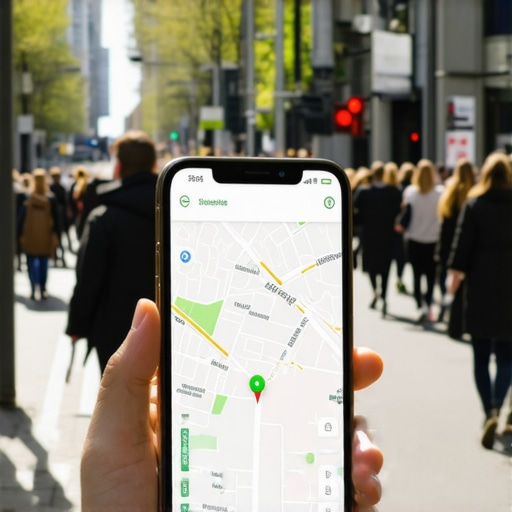
When you use most GMB rank trackers, you are looking at a snapshot of a vacuum. Google uses a distance-weighted signal that shifts based on the density of competition. In a high-traffic urban center, your ranking radius might only be 500 meters. If you move your phone to the next street corner, the Map Pack completely reconfigures. This is why your local search ranking tool is lying about your real position. It cannot replicate the way Google filters results based on the precise GPS coordinates of a moving vehicle or a pedestrian. We have to look at the math of the centroid; the central point of a business category’s density in a specific neighborhood. If you are outside that mathematical center, your visibility drops off a cliff, regardless of what your desktop software says.
“Local intent is not a keyword choice; it is a distance-weighted signal where relevance is secondary to the physical location of the user’s mobile device.” – Map Search Fundamental
The forensic trace of a service area polygon is another area where data diverges from reality. Most beginners think that drawing a larger circle in their GBP settings helps. It does the opposite. Google views an oversized service area as a signal of low specialization. I have used strategies to scale map visibility by tightening these polygons, not expanding them. When you align your digital footprint with the actual flow of your service vans, the algorithm rewards that consistency with higher local justification triggers.
The three mile radius that determines your revenue
The three mile radius is the primary filter for most high-competition service categories where Google prioritizes mobile proximity over brand authority. Businesses must optimize for the Vicinity filter by ensuring their NAP data is perfectly synchronized across all high-authority local directories and entity-based nodes.
I have seen business vanish from the map because they did not understand the physics of the local filter. Proximity is now the heaviest weight in the algorithm. This means a mediocre business that is 200 feet from the user will often outrank a world-class business that is two miles away. To fight this, you need a step by step gmb ranking toolkit for beginners that focuses on hyper-local signals rather than national SEO metrics. We are talking about the logic of a check-in signal; the mathematical weight of where a user actually clicks ‘Directions’ and then completes the trip. Google tracks this data through the Google Maps app on millions of phones. If people are not actually visiting your location, your rank will eventually reflect that lack of behavioral trust.
[image_placeholder_1]
This is why local SEO packages fail so often; they focus on building links from blogs that have no geographic relevance. You need clean backlinks from local news outlets, neighborhood blogs, and chamber of commerce sites. I once spent months cleaning up a profile because a client bought a ‘citation blast’ from a provider in another country. It created a mess of mismatched phone numbers that took a manual audit and removal plan to fix. Every incorrect mention of your business is a crack in your proximity beacon.
Local Authority Reading List
The forensic trace of a category change
Category changes trigger a complete re-evaluation of a profile’s local authority and can cause temporary or permanent ranking drops if the new category does not match the website’s structured data. Recovery requires aligning the primary category with the JSON-LD attributes and the service-specific content on the landing pages.
I have seen businesses lose everything because they thought a category change was a minor tweak. It is a major surgery. If you need services to recover GMB visibility after a category change, you must understand that Google is looking for immediate validation from your website. If your website still talks about ‘General Plumbing’ but your GBP is set to ‘Emergency Drain Cleaning,’ you create a relevance gap. The algorithm hates ambiguity. It smells like a scam. I often have to fix schema errors that were preventing the category signal from being confirmed. You need a gmb keyword and category research toolkit that identifies exactly which primary and secondary categories the top three competitors are using in your specific zip code.
“The Vicinity update fundamentally decoupled the keyword-relevance link, prioritizing the inverse square law of proximity over historical citation volume.” – Location Intelligence Whitepaper 2024
I despise agencies that sell ‘set and forget’ local SEO. Local search is a war of attrition. You have to monitor for competitors who are keyword-stuffing their business names. This is a direct violation of terms of service. I have been involved in many spam cleanup moves where we reported hundreds of fake listings to clear the way for our real clients. When you remove the noise, the real signals can finally reach the algorithm.
Why your physical address is a liability
Physical addresses become liabilities when they are located in virtual offices, shared suites, or industrial zones that do not match the business category’s expected location profile. Google uses Street View data and utility bill verification to ensure a business has a legitimate physical presence.
If you are sharing an office suite with a defunct law firm, you are asking for a suspension. I spent three months fighting a hard suspension for a plumbing client whose listing was nuked simply because of a suite number conflict. Google wanted proof of a utility bill under the exact GPS pin. If you are in this situation, you need gmb profile reinstatement services that know how to handle the evidence checklist. We had to take photos of the van, the signage, and the tools in the shop to prove the business existed. This is why sharing an office suite might be killing your rank. Google’s AI can see through the ‘executive suite’ facade using neural matching and historical imagery.
Even if you are not suspended, your location might be working against you. If you are on the edge of town, you are fighting a losing battle for the city center. You might need a geo-location fix that involves creating hyper-local landing pages for the neighborhoods you actually serve. This is not about keyword stuffing; it is about building geographic relevance through local events, partnerships, and specific neighborhood projects. It is about the local SEO audit path that looks at why you are stuck on page two. Often, it is a technical issue like a 404 error on a local page that is draining your authority.
Technical fixes for local pages
Technical SEO for local businesses must prioritize page speed, mobile responsiveness, and the elimination of redirect loops that confuse local search crawlers. Every millisecond of latency in a local landing page reduces the trust signal Google uses to rank the associated Map Profile.
A slow site is a local rank killer. I have watched profiles drop simply because a site migration went wrong. If you are going through a change, you need to protect local rankings during a URL structure change by mapping your redirects one-to-one. Most agencies miss this. They just redirect everything to the homepage and wonder why their map rank vanished. You have to map your redirects properly to maintain the link equity flowing to your location pages. If your website was hacked or infected, you need services to repair the website immediately because Google will pull your map listing to protect users from malware. The link between your website’s health and your map visibility is absolute.
We also need to talk about the specific schema fix that actually moves the needle. It is not just about having LocalBusiness schema; it is about having the ‘sameAs’ attribute correctly identifying all your social profiles and citations. This builds a web of trust that Google can follow. When I do a backlink audit, I am looking for toxic patterns that might trigger a filter. If you have been buying cheap backlinks, you need to identify and disavow them before the next algorithm shakeup wipes you out.
The reporting metrics that actually prove your software works
True local search success is measured by high-frequency proximity changes and the density of the ranking grid across a multi-mile area rather than a single keyword position. Success metrics must include phone call volume, direction requests, and the conversion rate of local justification snippets.
If your agency is just sending you a PDF with some green arrows, they are hiding the truth. You need to see the high-frequency proximity changes. You need to know how you rank at 8:00 AM versus 8:00 PM. Local search is temporal. In some industries, the Map Pack changes based on who is currently open. If you are not tracking this, you are flying blind. I recommend building a custom toolkit for tracking map results that integrates traffic data with ranking data. Because audits are useless without traffic data, you must see if those rankings are actually resulting in clicks. I have seen profiles rank number one for ‘plumber near me’ but get zero calls because their profile was filled with fake reviews issues that turned customers away. Trust is the final currency.